By Louise Irvine
Alan Tinter has been collecting kaleidoscopes since the 1980s, and he is excited to introduce this intriguing art form to WMODA as part of our International Museum Day celebrations on May 17. Alan will showcase some of his favorite kaleidoscopes created by contemporary designers, featuring fused, slumped, and flameworked glass barrels and cells. We can also have fun taking cellphone photos on Lief Colson’s Digi-Leidoscope, which are reflected in a spiked mandala using a three-mirror system.


Life is like an ever-shifting kaleidoscope – a slight change, and all patterns alter.
— Sharon Salzberg
The kaleidoscope was invented more than 200 years ago by a Scottish physicist, Sir David Brewster. He experimented with the polarization and refraction of light using angled mirrors and colored glass fragments or beads in a brass cylinder. When he gazed into his tube and turned it, he found the reflections transformed reality into symmetrical, ever-changing patterns. He called his invention the kaleidoscope from the Greek for “beautiful image watcher.” Before he could patent his accidental discovery in 1817 and partner with a manufacturer, his kaleidoscope was being copied as a street-corner amusement, and enterprising individuals offered “a penny for a peek.”


An enthusiastic correspondent in the Journal of Science and Arts maintained, “In the memory of man, no invention, and no work, whether addressed to the imagination or to the understanding, ever produced such an effect.” Brewster believed that he could disseminate knowledge through entertainment with his invention. In A Treatise on the Kaleidoscope, published in 1819, he presented diagrams of kaleidoscopes with multiple mirrors grouped together in the tube to show how the device could produce decorative patterns in record time and stimulate the imagination. “It will create, in a single hour, what a thousand artists could not invent in the course of a year.”
At the height of laughter, the universe is flung into a kaleidoscope of new possibilities. — Jean Houston
From stained-glass windows to carpets, designers could rely on the kaleidoscope and Brewster’s published diagrams for pattern inspiration. The public embraced this exploration of non-representational design, demonstrating mathematical beauty through a new creative tool. The kaleidoscope also influenced American quilt designs with a wide variety of geometric patterns following Charles Bush’s innovation of liquid-filled chambers in the 1870s. Kaleidoscope patterns continue to inspire artists today as evidenced by our new Mega Kaleidoscope mosaic mural by Allison Eden. Six years ago, we worked with an inspired young artist, Cassidy Lowe, who created kaleidoscopic patterns from her favorite pieces on display at WMODA. Her impressive work encouraged us to see our Fired Arts collection through a new lens.


Lori Brown, our expert graphic designer, has been inspired to experiment with making kaleidoscopic patterns in Adobe Photoshop. She started with one of Chelsea Rousso’s amulets of light to create an event graphic and is now trying out new software. Join Lori for some hands-on fun with patternmaking during our International Museum Day celebrations on May 17.


Mass production of the enhanced kaleidoscope in the Victorian era sparked a new craze for the novelty. The more expensive versions came with sets of slides featuring dried flowers, insects, and colored beads, all sandwiched between glass that could be swapped out. Over the course of a century, the kaleidoscope evolved from a popular parlor pastime into a cheap children’s toy. However, the Kaleidoscope Renaissance in the 1970s marked its rebirth as a modern art form, employing new materials and technologies.
In life’s kaleidoscope, we’re each a different piece of the puzzle. — Sarah Reinvalde
A new generation of designers combined science and art, making decorative barrel exteriors using glass, metal, and wood, and experimenting with mirror systems and cell contents. The development of dichroic glass, which produces shimmering, iridescent colors that vary with viewing angles and lighting, added a fascinating new dimension to kaleidoscope design.
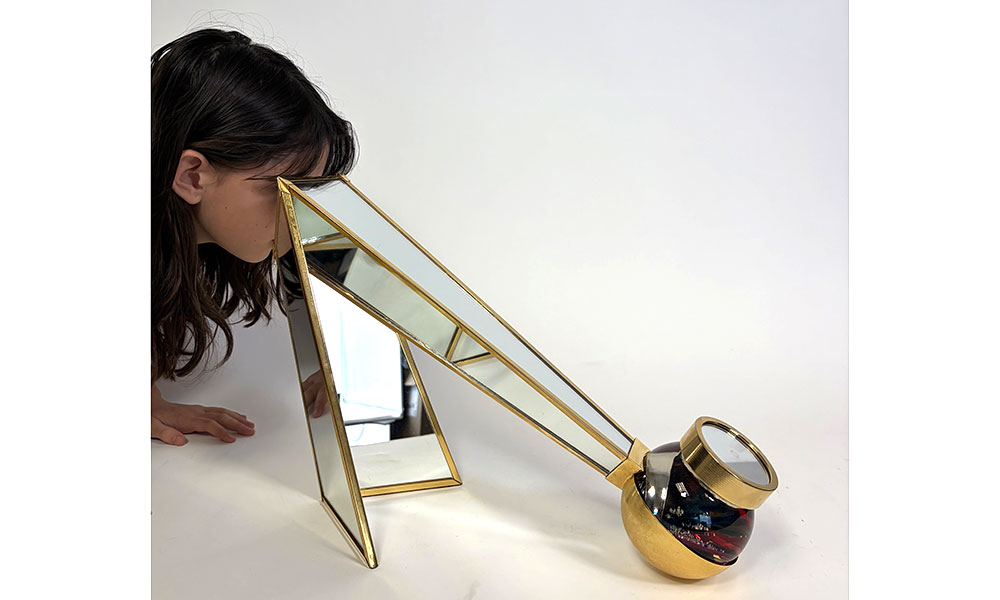


Quintet Kaleidoscope
Alan Tinter has acquired a collection of 150 art kaleidoscopes, and one of his most recent acquisitions is Paula’s Serendipity, made by Steve and Peggy Kittelson, which uses fused and slumped glass as the main medium for the barrel and cell objects. Peggy specializes in tiny torch-worked flowers encapsulated in the cells, inspired by the flora and fauna of their Iowa farm. They express their metaphysical connection with their designs: “Kaleidoscope images are like precious moments in time that we must cherish because once they are gone, we can never get them back.”
There is no such thing as a new idea. We simply take a lot of old ideas and put them into a sort of mental kaleidoscope. — Mark Twain
Alan is an enthusiastic member of the Brewster Kaleidoscope Society, an organization founded in 1989 to provide a forum for artists, collectors, and retailers to promote and perpetuate kaleidoscopes as a unique art form. In their words, “Our membership represents everyone with color in their soul and wonder in their hearts from all livable continents and multiple countries.”
Like a kaleidoscope, life is ever-shifting — a mosaic of challenges, triumphs and fleeting moments of beauty. — University of Alberta
A kaleidoscope is a powerful metaphor for life. With every small “turn” or change in perspective, new patterns, colors, and infinite possibilities emerge. Just as broken, chaotic fragments create beauty, the diverse, ever-changing moments of existence form a unique, ever-evolving masterpiece.

Join us on Sunday, May 17, when we celebrate International Museum Day at WMODA and discover more about kaleidoscopes from Alan Tinter.